desktop 🠖 interface documentation
Narrative Pedigree
Type:
Data Visualisation
Creates:
Nothing — it visualises the family pedigree built in another stage
Uses Prompts:
false
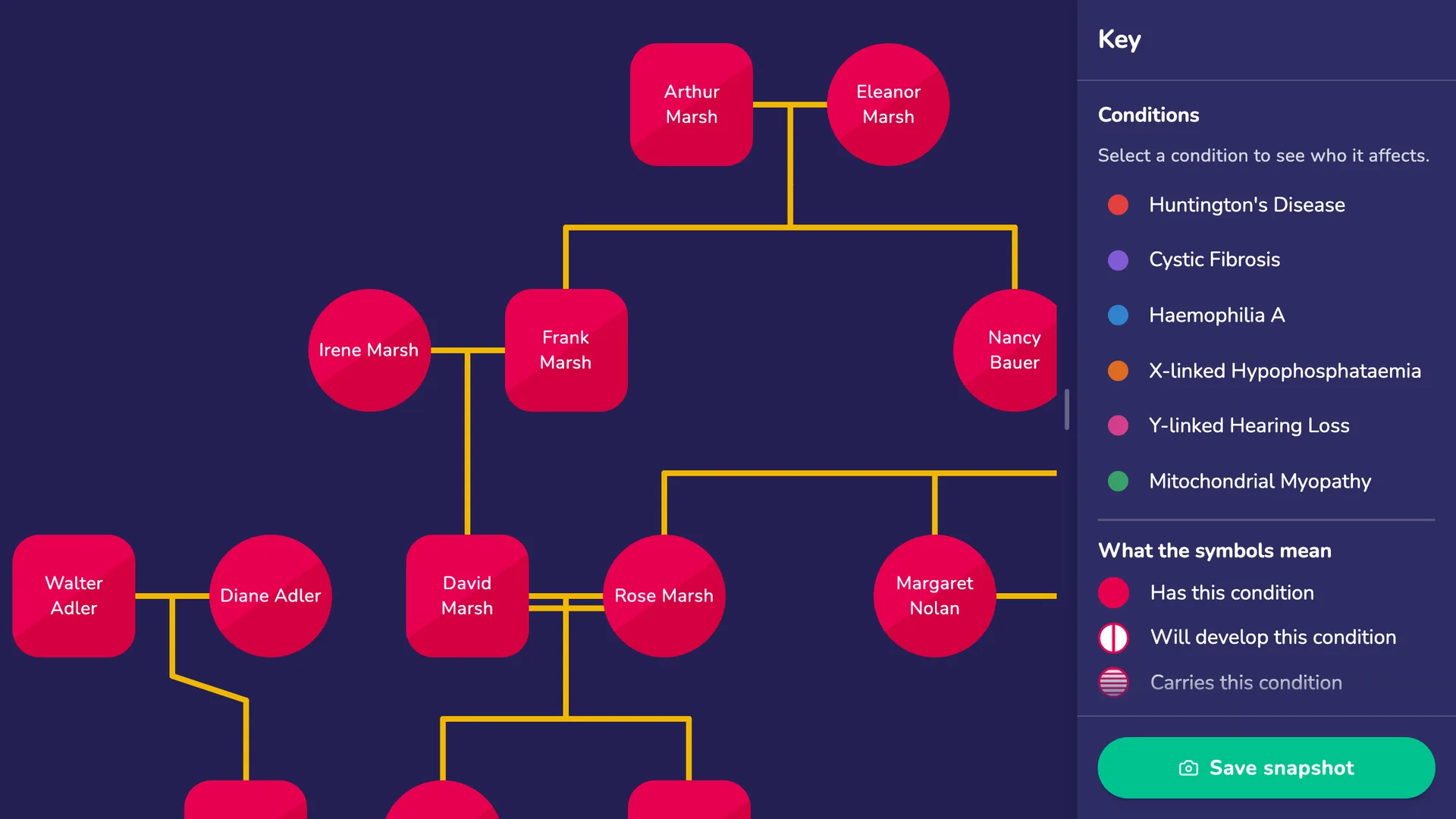
The Narrative Pedigree is a companion to the Family Pedigree. It takes a family pedigree the participant has already built and draws it using standard pedigree notation, overlaying inheritance information for one or more conditions. It does not create or change any data — it only reads and displays the pedigree from its source stage.
Use it to show, at a glance, who in the family is affected by a condition, who must carry it, and (optionally) who may be at risk — with the drawing rules following the standard clinical conventions described in Bennett et al. (2022).
Choosing the source stage
The Narrative Pedigree always reads from an earlier Family Pedigree stage in the same protocol. Select that stage as the source. The Narrative Pedigree then shows exactly the people that stage recorded — it will not pick up unrelated people added in later stages, even if they share the same node type.
Configuring conditions
Add one or more conditions to display. For each condition you set:
- Label — the condition's name, shown in the key.
- Colour — the colour used to draw that condition's status on the pedigree.
- Node variable — a boolean variable that records whether each person is affected. This is normally collected in the Family Pedigree disease-nomination step. Only boolean variables can be selected, because "affected" is a yes/no value.
- Inheritance pattern — how the condition is passed down. This drives every inference the interface makes, so it must be correct.
Supported inheritance patterns are: autosomal dominant, autosomal recessive, X-linked dominant, X-linked recessive, Y-linked, mitochondrial, multifactorial, and unknown. For multifactorial and unknown, only the people explicitly nominated as affected are shown — no carrier or at-risk inference is made.
How statuses are shown
Each person is drawn with a shape for their biological sex (square for male, circle for female, and a diamond where the sex is not known), and a fill or marker for their status with respect to each condition.
Certain statuses include affected, will develop it (an obligate/presymptomatic case), and carrier. These are drawn using the standard nomenclature symbols and explained in the on-screen key.
Possible (at-risk) statuses
There is a Show possible (at-risk) statuses option, which is off by default. When it is off, the pedigree shows only certain statuses. When it is on, it also shows may develop, may carry, and may be affected — drawn as the usual symbol with a question mark added.
At-risk statuses are inferred, not observed. They are a strong visual signal that can be misread as established fact, so they are intended for clinician-directed use, where a professional interprets them in context. Standard pedigree nomenclature deliberately does not encode probabilistic risk.
How inheritance is inferred
When at-risk statuses are shown, the interface works out possible statuses from the family structure and each condition's inheritance pattern. A few rules are worth knowing, because they shape what researchers and clinicians will see:
- Only biological connections transmit. Only biological and donor relationships pass a condition on. Social, adoptive, surrogate, and partner relationships never do, so risk is never inferred across them.
- Unknown sex stays uncertain. Sex-linked inheritance (X-linked, Y-linked, mitochondrial) depends on biological sex. Where a person's sex was not recorded, the interface leaves inheritance through that person uncertain rather than guessing. This is why capturing sex recorded at birth in the Family Pedigree matters.
- X-linked risk follows the maternal line. For X-linked recessive conditions, risk travels down the mother's X chromosome. Relatives connected only through an unaffected father — for example, a mother's half-sibling who shares only her father — carry none of that X and are correctly not marked at risk.
Throughout, the interface assumes conditions are fully penetrant (everyone who has the genotype shows the condition) and treats inference as a guide to where to look, not a substitute for clinical assessment.
Focusing on one person
Selecting a condition from the key switches the pedigree to that condition's view. From there, focusing on a person highlights the relatives who contribute to their inheritance of the selected condition, following the true source line for that pattern (for example, up the maternal line for an X-linked condition). A printable snapshot of the current view can be exported.
Best practices
Record who is affected using a boolean variable per condition (via the Family Pedigree disease-nomination step), and set each condition's inheritance pattern carefully — every inference depends on it.
Capture sex recorded at birth for each person in the Family Pedigree. Sex-linked conditions cannot be traced without it, and missing sex is treated as uncertainty.
Try to avoid
Don't enable at-risk statuses for participant-facing use without a clinician. Inferred "may be affected" or "may carry" symbols can be mistaken for a diagnosis.